 DX
DXSchedule truth
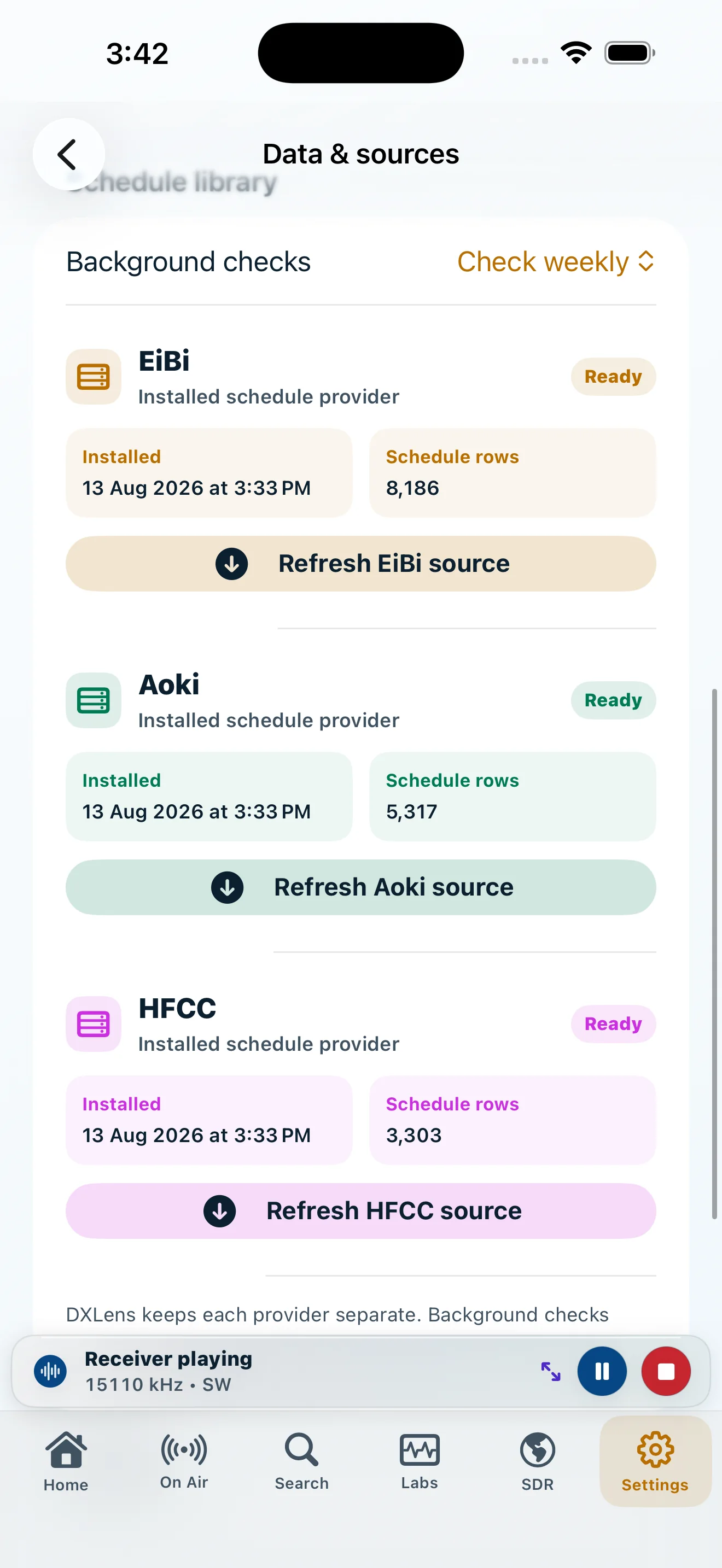
EiBi
International shortwave schedule records and source remarks.
Aoki / NDXC
Independent schedule records and technical enrichment.
HFCC
Coordinated schedule and transmitter technical information.
DXLens keeps schedule, model, environmental, map, and receiver evidence distinct and attributed.
Schedule providers remain named on result cards. Forecast methods and technical provenance remain inspectable. Environmental context and public receiver directories are described according to the role they actually play.
International shortwave schedule records and source remarks.
Independent schedule records and technical enrichment.
Coordinated schedule and transmitter technical information.
Modeled HF path calculations and technical forecast outputs.
Operational solar, geomagnetic, and absorption products.
Coronal mass ejection and space-weather event context delivered through the DXLens gateway.
Geographic and contextual mapped features.
Weather context used where enabled.
Map presentation and geographic interaction on supported platforms.
Public receiver discovery and directory context.
Independently operated receiver endpoints and capabilities.
Availability, listener capacity, policies, and live service remain operator-controlled.
A direct connection protocol for a user-configured RTL-SDR host. It is a receiver transport, not a schedule or forecast data source.
Host, port, RF profile, and performance settings are configured by you and used to connect directly from the app.
Schedule sources publish planned transmission data; they do not measure reception.
Propagation models calculate path prospects from available inputs; they do not observe your antenna.
Environmental sources provide context; they do not prove local RF noise or station activity.
Receiver directories help discover public receivers; availability remains with each independent operator.
RTL-TCP is a direct receiver transport configured by the user; it is not a DXLens schedule, forecast, or public-directory data source.